Christmas
Midwinter BreakChristmas is a recurring frame for the Gilmores’ intimacy and estrangement: a night of midnight Mass, cold streets and shared gifts also reveals how much of Stella’s religious life Gerry has not seen. Its memories return during their Amsterdam trip, when ordinary gestures of prayer and care sit beside his growing sense that he may no longer know his wife as well as he thought.
The Christmas observance
Gerry accompanies Stella to midnight Mass because he does not like the thought of her walking alone through dark streets at one o’clock in the morning. The arrangement contrasts with her usual Christmas routine: she rises early on Christmas Day and goes to church by herself. At Mass, Gerry knows the sequence from childhood, but his familiarity does not amount to belief. He sits beside Stella, content not to take part, in a mock-Gothic church whose pointed arches and altar recall the Victorian churches built in the manner of Pugin. His recollection of childhood worship is bodily and watchful: as a boy, he was made to face the altar, while his mother corrected him if he looked elsewhere, so he studied the backs of the adults in front of him—the mark left by a man’s hat or the colours of a woman’s headscarf.
The present-day service initially seems comfortable to him precisely because he can remain an observer. That position shifts when the priest invites the congregation to exchange a sign of peace. After kissing Stella and shaking hands with strangers, Gerry learns that she and Sister Francis are serving as Eucharistic ministers that night. Stella leaves him and goes up the side aisle; at the altar, she receives communion with Sister Francis and then helps distribute hosts from a gold chalice to the approaching congregation. Gerry watches her stoop to each person. Her rounded shoulders make him think of her as old, and the sight leaves him feeling that he is looking at someone he does not fully know.
After communion, Stella returns to her seat and kneels with her face in her hands while the choir sings “In the Bleak Midwinter.” Gerry hears her take a shuddering breath and sees her reach for a handkerchief. He suspects she may be distressed about being separated from their son and grandson at that time of year, but he cannot tell whether that is the cause. He wonders whether Stella’s dry eye condition prevents her from weeping, then asks if she is all right. She turns away, as if her grief were not his to witness, and offers no explanation. The service thus makes her faith visible to him while leaving the feeling beneath it private.
Service, faith, and the walk home
On the walk home, Gerry finally asks about her role, fumbling for a description before Stella supplies the correct title: Eucharistic minister. She has been doing it for a couple of years. When Gerry asks whether she wants him kept informed about such things, she points out that he simply did not know. Her explanation is direct: she was asked and said yes because she wanted to help in any way she could. Gerry says he is proud of her, while acknowledging that he does not believe in what she believes. Stella asks him not to say anything more; it is Christmas, and she feels good.
Their walk holds both physical discomfort and a small return to closeness. They hurry through the cold, watching for slippery patches beneath a fog-lit street, until they reach a hill. Stella eases her arm through Gerry’s and pulls against him a little. She teases him for hurrying when they have no child waiting at home. Gerry slows and explains that he wants to get out of the cold and into central heating. He asks whether she feels better, but her response is tight-lipped. He then asks her to tell him again about her eye condition; the question does not produce an account of what had upset her. Christmas brings them into the same church and home, but it does not make every part of Stella’s experience available to him.
Home, food, and exchanged gifts
At home, the scene changes from the cold street to a flat warmed by Christmas preparations. The pudding has been boiled, gravy stock made with giblets, and a potted hyacinth sweetens the hallway. Stella has made ham sandwiches and wrapped them in cling film. Gerry pours her sherry and himself an Islay malt, and they toast Christmas together. Food, drink, warmth and shared attention make a domestic ritual of the return from Mass, even as their different relationships to faith remain plain.
Stella gives Gerry an envelope that has arrived that day. It is not his main present, she explains, but a gift for both of them: tickets for Amsterdam. She has booked through a travel agent because she wanted to be sure, rather than booking online to save a little money. Gerry jokes about the tickets arriving in the Christmas post; Stella answers with a smile and a shrug. The trip enters their marriage as a jointly planned future, made tangible in an envelope given at home.
Gerry, in turn, produces a tiny parcel wrapped with conspicuous Sellotape. Beneath the loose paper is a small black domed box containing earrings. He chose them because Stella had not liked the idea of an eternity ring, and he calls them eternity earrings. The gift recalls how pleased she had been when she first had her ears pierced. Stella removes the earrings she wore to Mass and begins fitting the new pair. The exchange joins the religious service to the couple’s private history: the word eternity is redirected from a ring she rejected to earrings she can wear, and Gerry’s present rests on remembering a detail of her younger self.
A memory carried into Amsterdam
During the Amsterdam trip, Gerry recalls the Christmas Mass while sitting in the hotel room after Stella has gone to bed. Her distance at dinner has made him wonder whether he is still part of her imagined future. He remembers the church not simply as a familiar service but as the night he saw her doing work he had never known she did. The memory sharpens his uncertainty: he had been beside her for years, yet her two-year service as a Eucharistic minister had remained outside his knowledge.
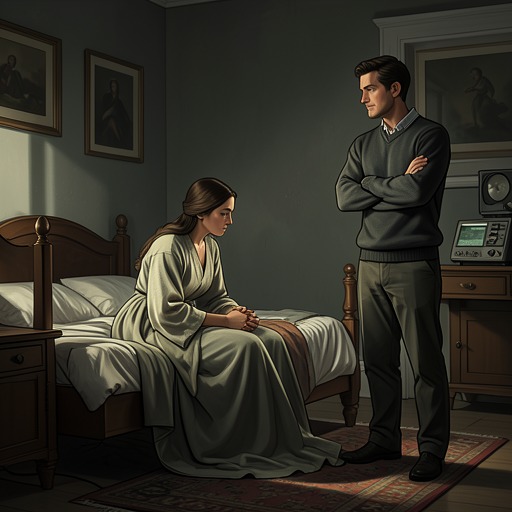
In another hotel-room scene, Gerry sees Stella kneeling beside the bed in her white nightdress and realizes she is praying. He almost speaks, intending to make a joke, but stops because he rarely sees her pray. At home they go to bed at different times, giving each other space, and he had not known she still kept this practice. Stella uses a mantra to hold her attention as she prays through the people she loves—her parents, siblings and family across the world—and gives thanks for the life she has lived and her survival. Her recollection of her father’s body laid out in the front room, watched so that he would not be alone, brings the dead into this nightly act of care. She also prays for refugees and people fleeing war, though she regards such prayers as a form of spiritual tidying, something done morning and night to set the world to rites. Gerry waits without interrupting as she finishes, makes the sign of the cross and stands.
Across these scenes, Christmas is not merely a festive backdrop. Mass reveals a public commitment that Gerry had overlooked; the walk home offers physical closeness without requiring Stella to explain her grief; and the meal and gifts establish a shared domestic future in Amsterdam. The later sight of her prayer shows that religious practice is not confined to the church or the calendar: it continues privately, beyond Gerry’s view, and makes his belated recognition of Stella’s inner life part of the trip’s larger reckoning.